Mork CapitalManagement, LLCLogin
AboutApproachCommentariesContact

About

Established 1983.

Investing since 1969.

Mork Capital Management is a private investment firm in Healdsburg, California. We have operated within a few blocks of the Healdsburg Plaza since 1983; the firm restructured as the current fund, MCAPM, L.P., in 2002 and serves a small group of limited partners.


Principals

Michael Mork, CFA

Founder · Chief Executive Officer

Michael’s first experience with stocks was as a runner at the Minneapolis Stock Exchange, changing numbers on the quote board. He was on the floor on November 22, 1963, the day President Kennedy was assassinated. As the market collapsed, he watched a group of old-timers, smoking cigars, methodically begin buying blue-chip companies that had fallen dramatically. When the market reopened, it rebounded sharply — America would persevere. The lesson stuck.

After serving in the U.S. Coast Guard, Michael took a night-shift job processing trades in the back office of a brokerage house — and came in early each day to use its research library on his own time, studying companies and new issues. There he befriended an analyst using the same library: Roger Engemann. A year later, in 1969, Roger got the opportunity to manage money and hired Michael as his first employee at what became Roger Engemann & Associates, the Pasadena investment firm — the two remain best friends to this day.

Michael remained at the firm as a stock and economic analyst and portfolio manager until 1983, when he founded Mork Capital Management in Healdsburg. He restructured the firm as MCAPM, L.P. in 2002, with Mork Capital Management serving as the Fund’s general partner from inception. The general partner converted to a limited liability company in 2015. Michael earned the Chartered Financial Analyst designation in 1975.
Peter Mork, CFA

Portfolio Manager

Peter is the portfolio manager and has been with the firm since 2006. Before joining Mork Capital, he was a research analyst at La Jolla Economics from 1999 to 2005. He earned the Chartered Financial Analyst designation in 2006 and serves on the board of directors of NXT Energy Solutions, Inc., a portfolio company.


Team

Cody Mork

Operations · with the firm since 2025

Cody holds a degree in Economics from the University of California, Berkeley. Before joining the firm in 2025, he worked on oil rigs, at technology companies, and ran operations at Limerick Lane Cellars in Healdsburg.

Valarie Norris

Office Manager, 1988–2025 · on contract


A long view.

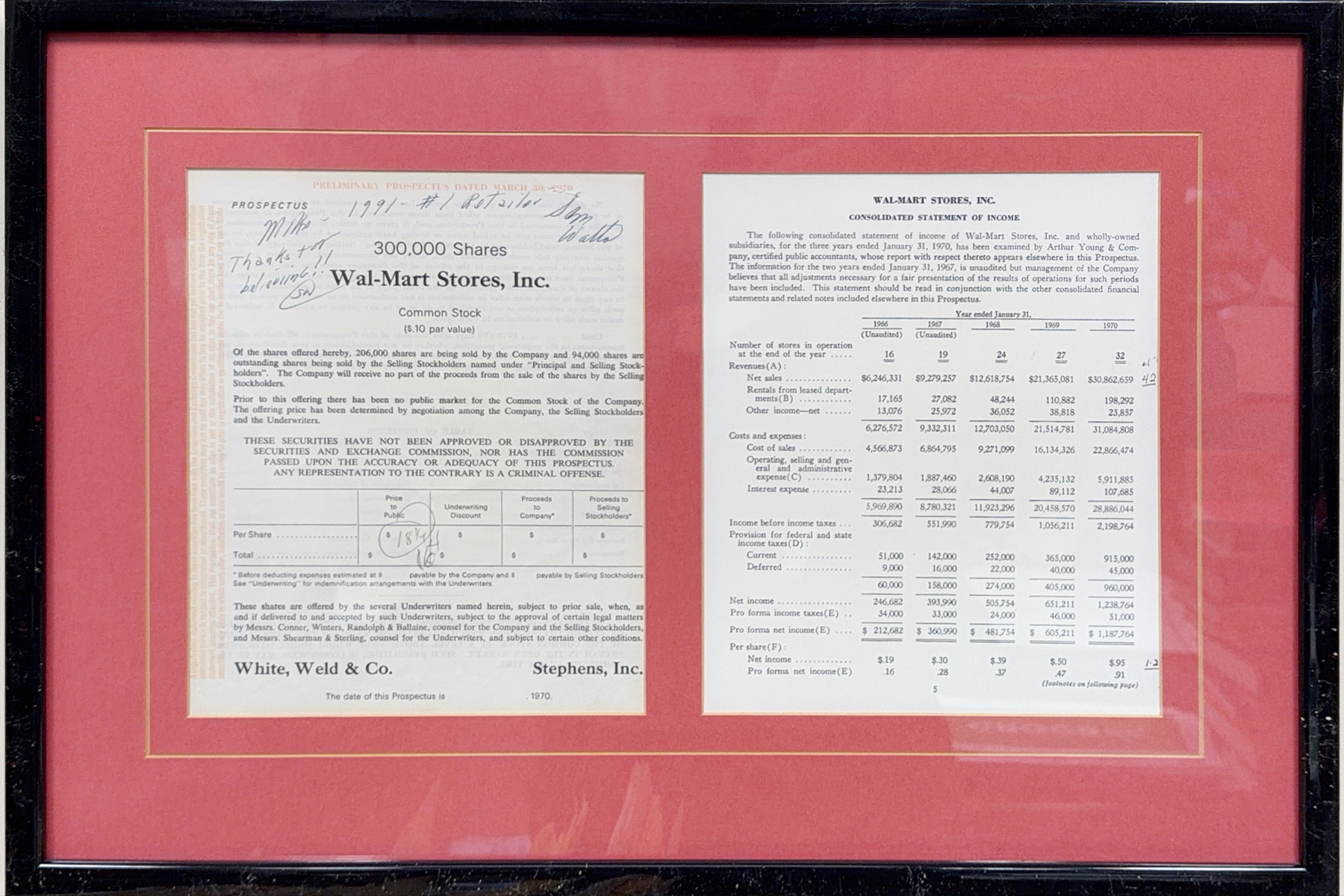
The 1970 Wal-Mart Stores, Inc. preliminary prospectus, signed in 1991 by Sam Walton with the inscription ‘Thanks for believing.’
Wal-Mart Stores prospectus, 1970 · inscribed by Sam Walton, 1991

In February 1970, Wal-Mart Stores, Inc. filed to go public with an offering of 300,000 shares. The lead underwriter was Stephens, Inc. of Little Rock. After meeting Sam Walton at the road show, Roger Engemann and Michael wanted to participate. The deal had to be pulled: the company was an obscure Arkansas retailer and the underwriters could not find enough buyers. Wal-Mart eventually went public later that year. Through that early involvement Michael came to know the principals at Stephens well, and a long friendship with Sam Walton developed alongside, including quail-hunting trips in Arkansas.

Michael toured the original Wal-Mart stores personally with Sam, and credits him with a lasting lesson from those visits: the way a company motivates and retains its talent — its incentive structure — is among the keys to long-term shareholder value. That lesson still shapes how the firm evaluates the management teams of the companies it owns.

Twenty-one years later, after Wal-Mart had passed Sears to become the largest retailer in the world, Sam Walton signed Michael’s copy of that pulled prospectus and inscribed it: “Thanks for believing.”

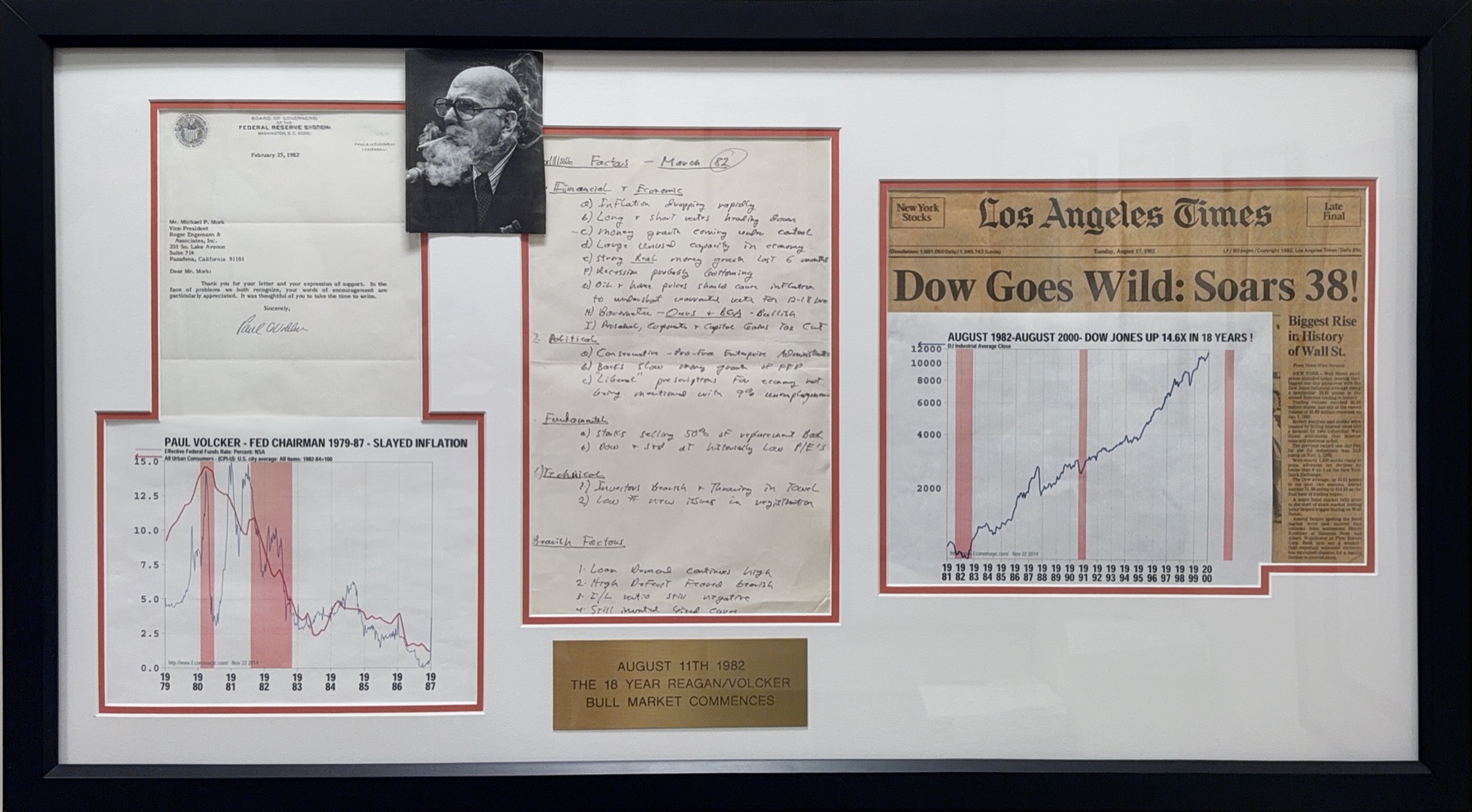
A framed display containing a February 1982 letter from Federal Reserve Chairman Paul Volcker to Michael Mork, Michael’s own handwritten ‘Bullets Posted — March 1982’ list of economic indicators, a Fed funds rate chart, and an August 1982 Los Angeles Times clipping marking the start of the Reagan/Volcker bull market.
Letter from Paul Volcker, Chairman of the Federal Reserve · February 25, 1982

In early 1982, with the Fed funds rate above fourteen percent and inflation finally breaking after Volcker’s tightening cycle, Michael was corresponding with the Federal Reserve Chairman. His own running list of indicators that month is mounted alongside — an early version of the analytical framework that would later become the Barometer.

Six months later, on August 11, 1982, the Dow began a bull market that would compound for the next eighteen years.

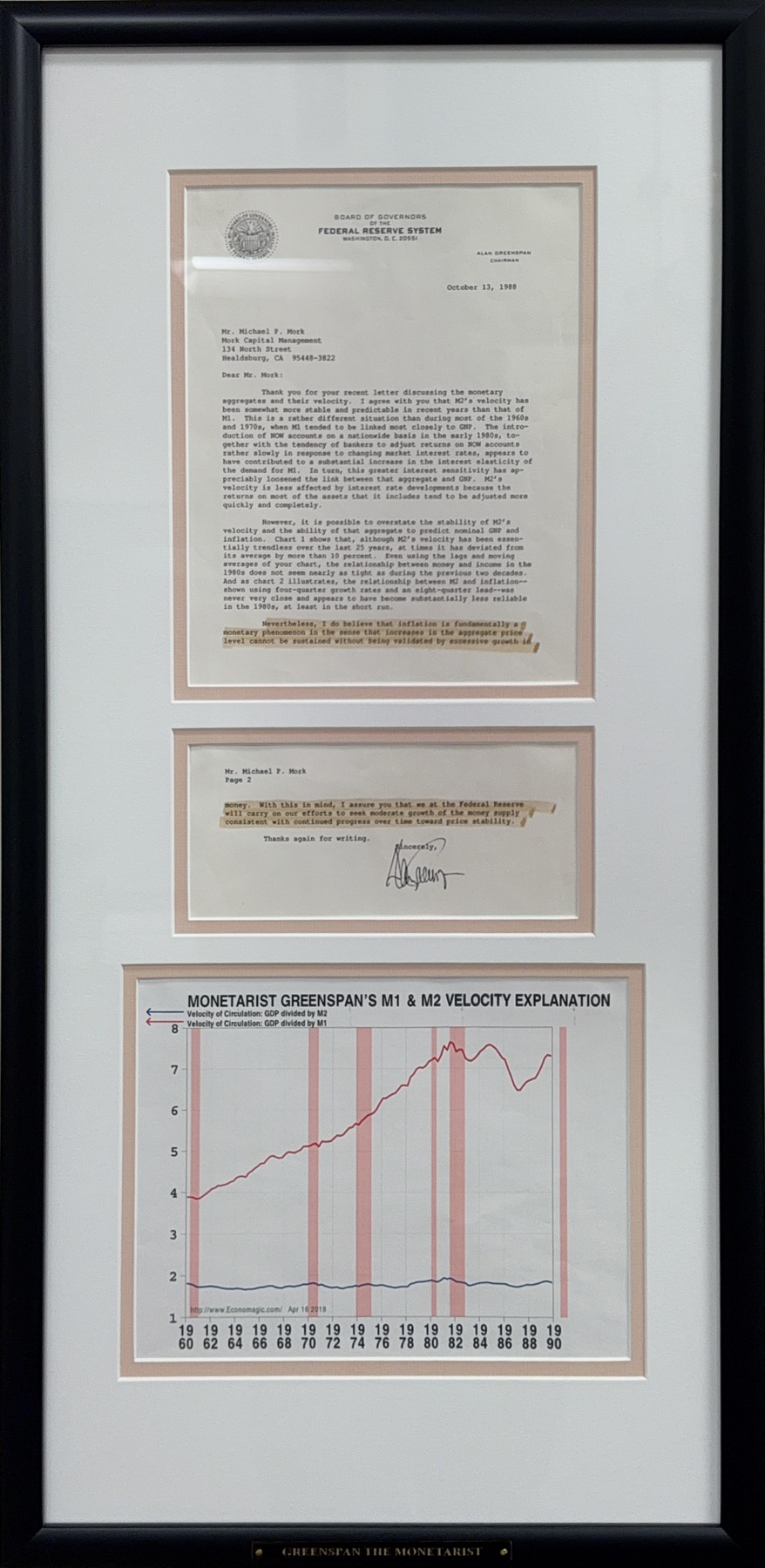
A framed display of an October 1988 letter from Federal Reserve Chairman Alan Greenspan to Michael Mork on Federal Reserve letterhead, with Greenspan’s handwritten note and a chart titled ‘Monetarist Greenspan’s M1 & M2 Velocity Explanation.’
Letter from Alan Greenspan, Chairman of the Federal Reserve · October 13, 1988

The Fed correspondence continued through the transition of leadership. Fourteen months into his chairmanship, Alan Greenspan wrote to Michael on questions of monetary aggregates and velocity — questions Michael had been tracking for more than a decade by then.

Greenspan’s own framework, as the accompanying chart documents, leaned more monetarist than is commonly remembered.

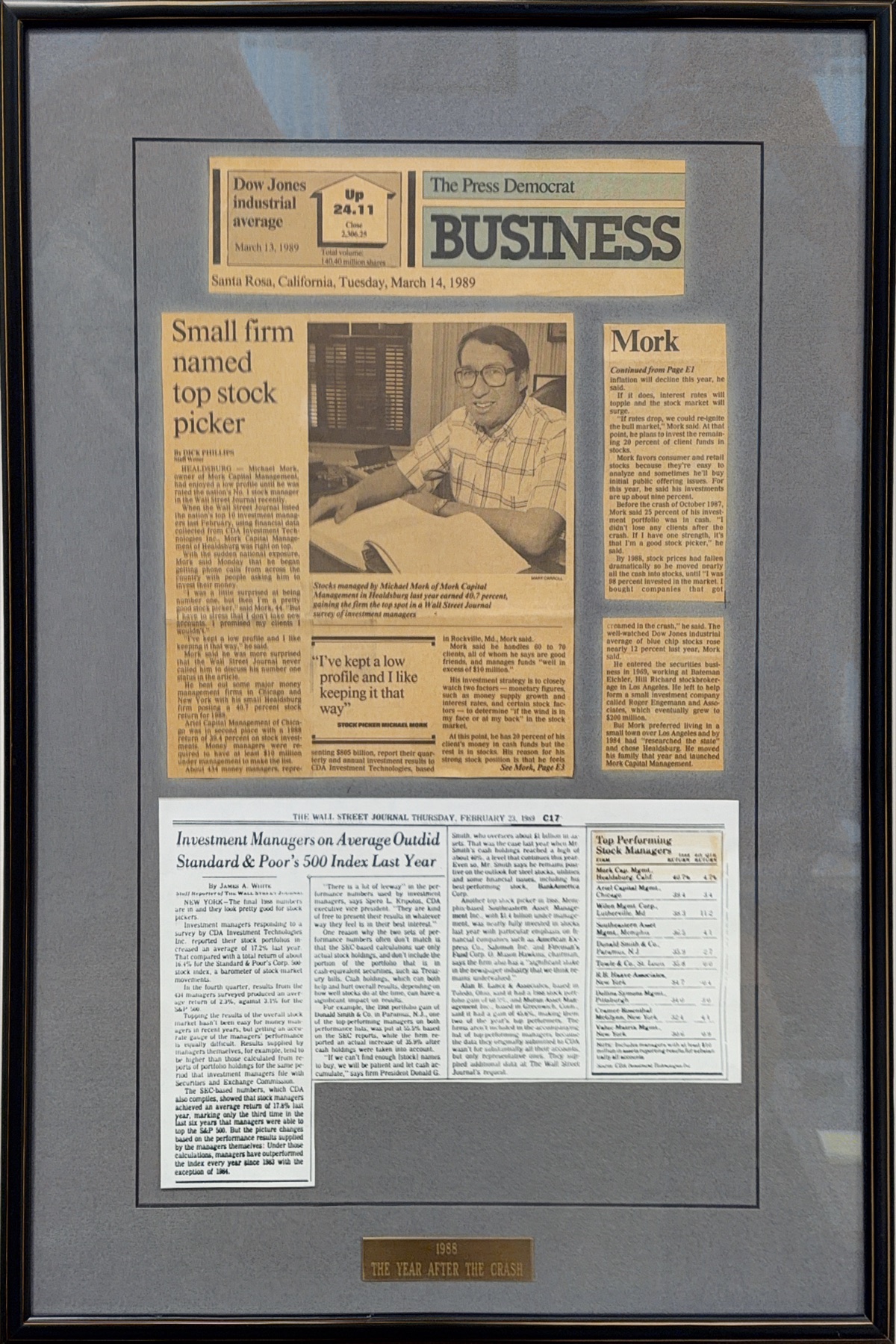
A framed assembly of clippings showing the March 14, 1989 Press Democrat article ‘Small firm named top stock picker,’ the February 23, 1989 Wall Street Journal Top Performing Stock Managers ranking with Mork Capital Management at #1, and a plaque reading ‘1988 — The Year After the Crash.’
1988 · The Year After the Crash

1988 was the year after the crash. In February 1989, the Wall Street Journal named Mork Capital Management the top-performing investment manager in the United States for the prior year. Calls came in from across the country looking to invest. Michael declined every one of them. He had made a promise to the clients he already had, and he kept it:

“I have to stress that I don’t take new accounts. I promised my clients I wouldn’t.”

Source: The Wall Street Journal, February 23, 1989, citing data compiled by CDA Investment Technologies Inc. The ranking covered investment managers with at least $10 million in reported assets, reporting results for substantially all accounts. Mork Capital Management did not pay for or solicit the ranking. Past performance does not guarantee future results. See Disclosures.

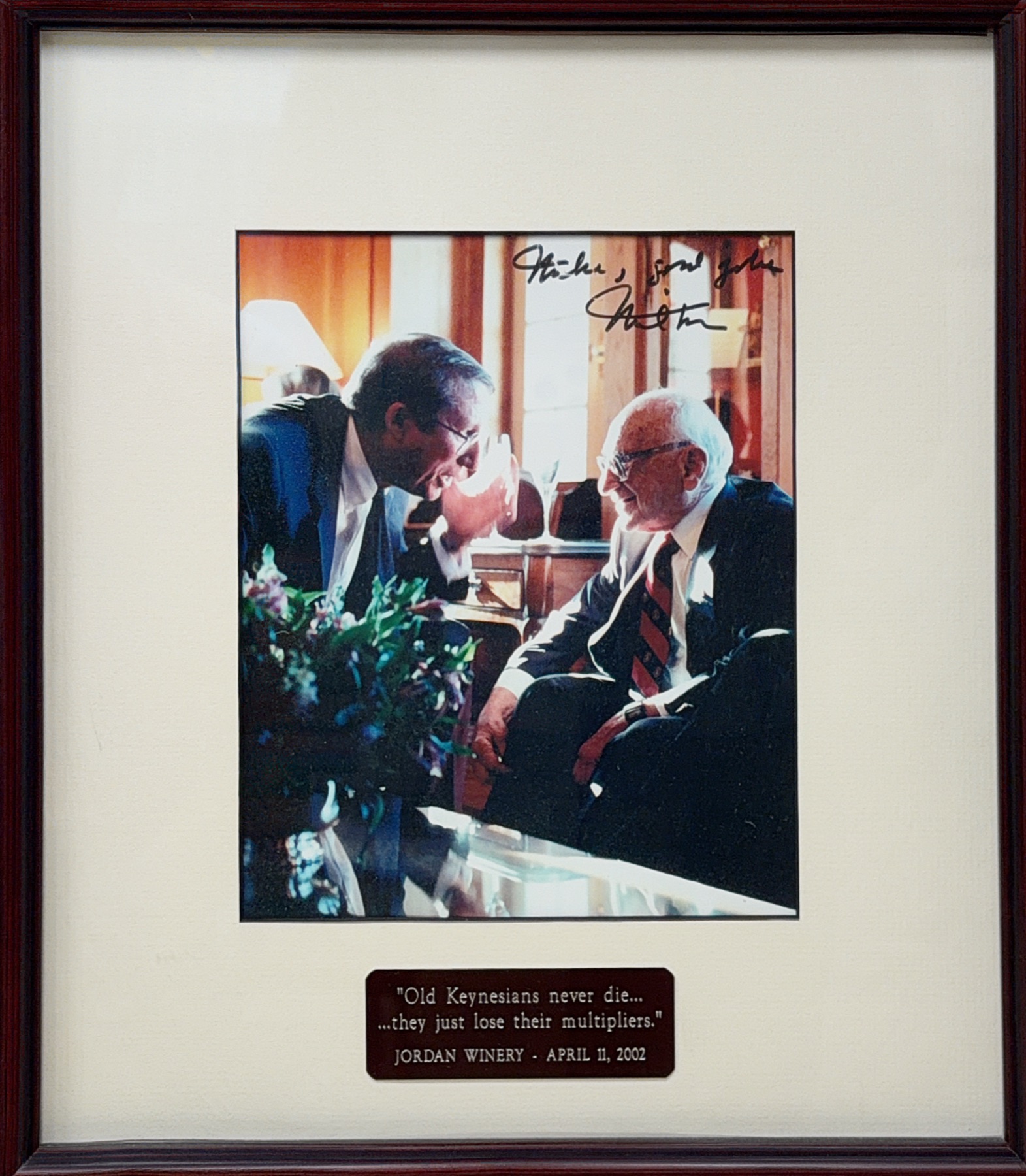
A signed photograph of Michael Mork in conversation with Milton Friedman at Jordan Winery in 2002, inscribed by Dr. Friedman to Michael, beneath a plaque reading ‘Old Keynesians never die… they just lose their multipliers.’
Jordan Winery, Sonoma County · April 11, 2002

Michael began corresponding with Milton Friedman in the mid-1970s on questions of monetary theory and Federal Reserve policy. By the 1990s the correspondence had become regular visits, and on a 2002 trip Dr. Friedman came north to Sonoma County. The plaque on this photograph carries one of his favorite lines on monetary versus Keynesian thinking.

Earlier that same year, on May 9, 2002, when President George W. Bush honored Dr. Friedman at a White House event, Michael and his wife Carol were among the select few personal guests Friedman invited to the ceremony.

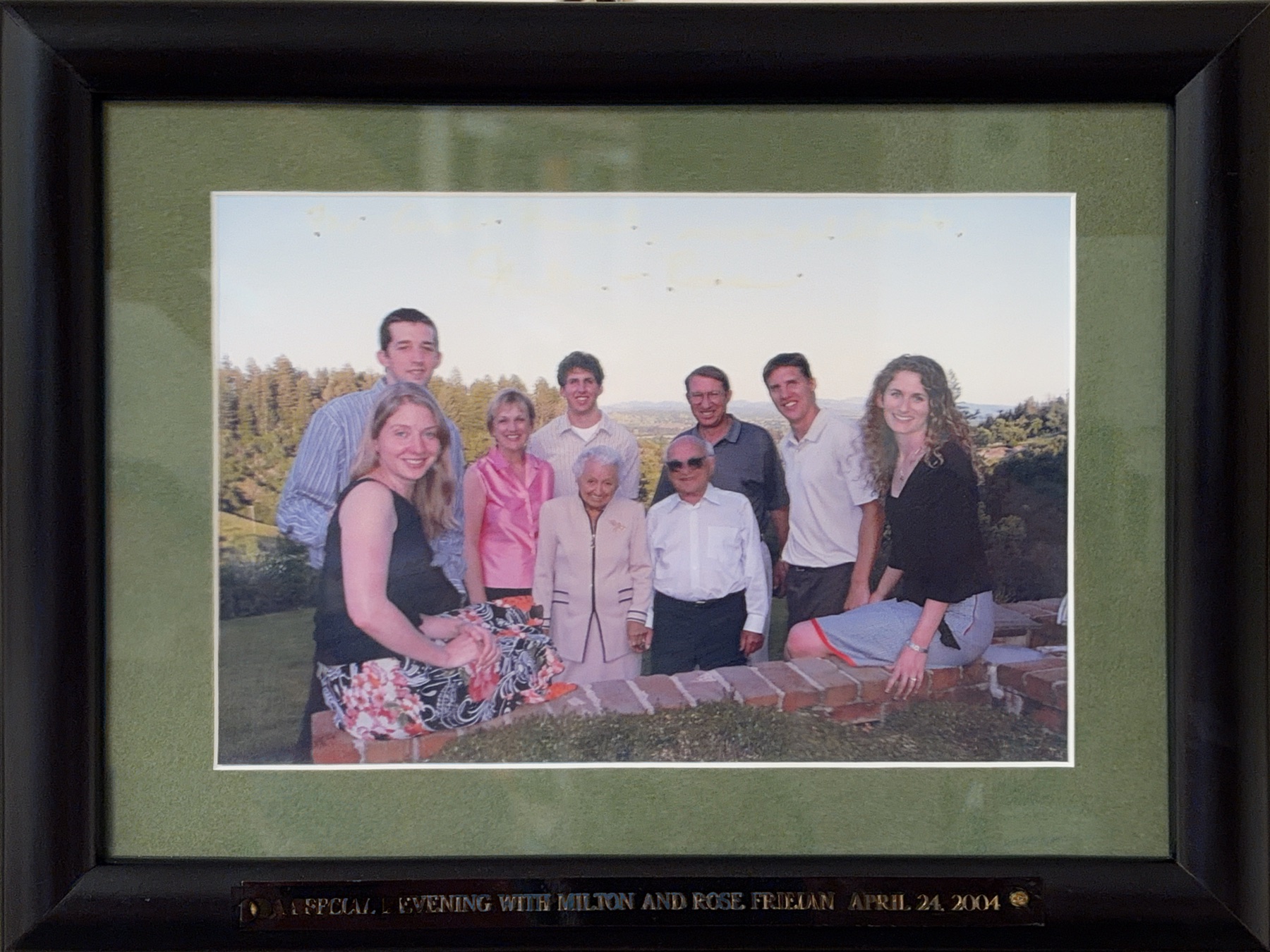
A framed photograph of the Mork family with Milton and Rose Friedman, mounted with a plaque reading ‘A Special Evening with Milton and Rose Friedman, April 24, 2004.’
A Special Evening with Milton and Rose Friedman · April 24, 2004

From the mid-1990s until Dr. Friedman’s passing in 2006, Michael and Carol met several times a year with the Friedmans at their San Francisco residence. This gathering, on April 24, 2004, was two years before Dr. Friedman passed.

In the early 1970s, after regression analysis of more than one hundred macroeconomic variables, Michael had identified seven indicators that proved most reliable for forecasting U.S. economic cycles — what he came to call the Barometer. He shared the work with Dr. Friedman, who later credited Michael with prompting the switch from nominal to real (deflated) M2 as a predictive measure. At the time, only two of the seven indicators were part of the Conference Board’s Leading Economic Indicators; today, six of them are.

That mentorship continues to inform the firm’s economic perspective and the monetarist orientation of the commentary published on this site.

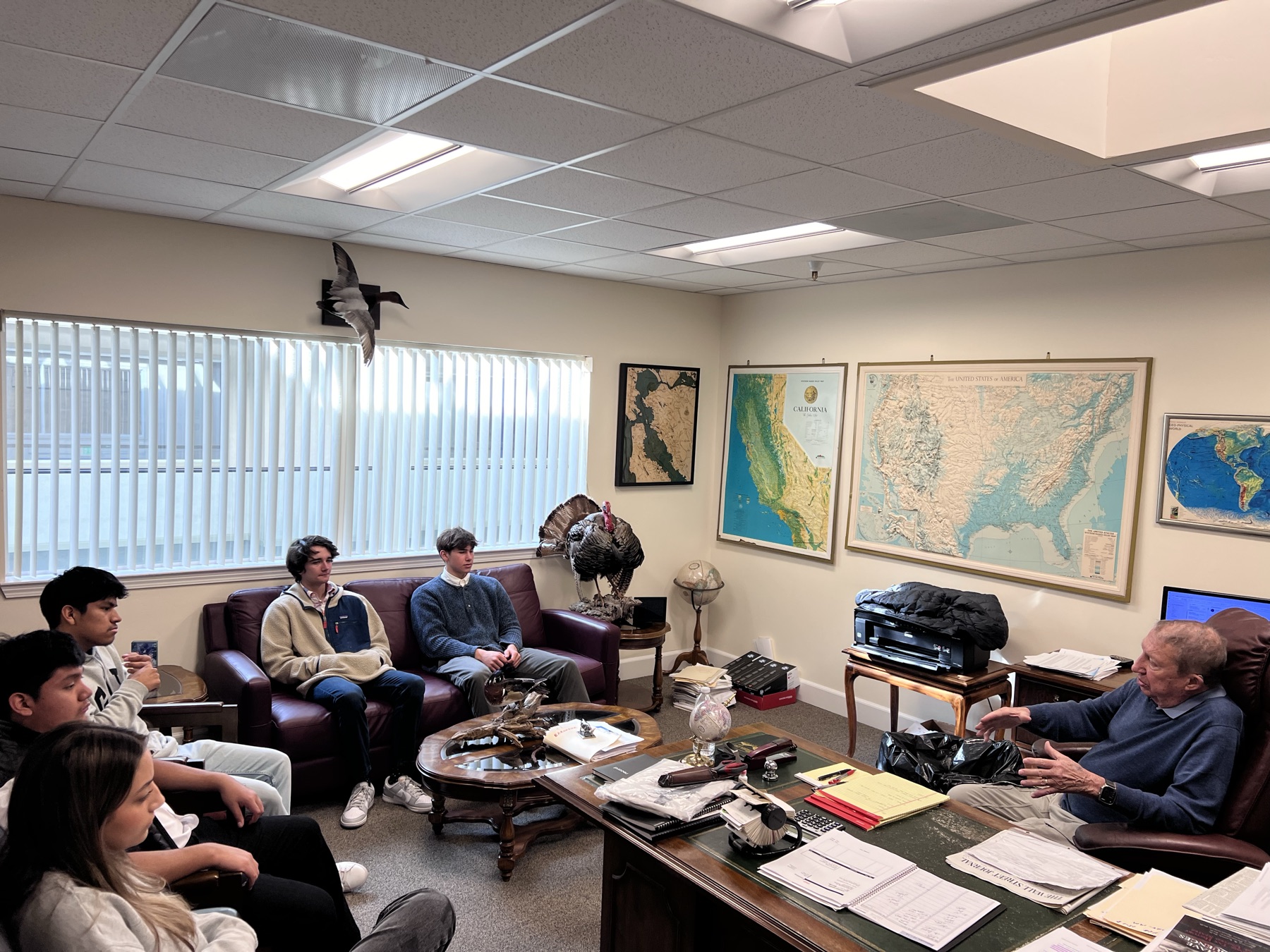
Michael Mork at his desk in the firm’s Healdsburg office, in conversation with a class of Healdsburg High School juniors seated on a couch and chairs.
Healdsburg High School Internship Program · Mork Capital intern class

Each January and February since 2018, the firm has hosted juniors from the Healdsburg High School Internship Program — Sonoma County’s only program of its kind, supported by the Healdsburg Education Foundation. Over six days, students learn to read financial statements, study the equity markets, research a public company they visit in person, and present their findings to a panel at the school.


Structure & service providers

Firm founded
1983
Fund
MCAPM, L.P. · California limited partnership (2002)
General partner
Mork Capital Management, LLC · general partner since 2002
Fund administrator
Maples Fund Services (MA) Inc.
Prime broker
Jefferies LLC
IRA custodian
Royal Bank of Canada
Auditor
Thomas Rackerby, CPA
Fee verification
Patrick Paquette, CPA
Legal counsel
Law Offices of Kevin McGee
Compliance
Core Compliance Legal Services
Outsourced CCO
Rashaunia Fuller, Sr. Compliance Consultant

Office

132 Mill Street, Suite 204
Healdsburg, California 95448